As notes accumulate in Obsidian, three things that look similar are tempting to keep together: what an article said, what happened at the time, and my thoughts connecting the two. I used to think I could put everything in one note, add enough tags, and find it later.
Over time, it became difficult to tell what came from the source, what reflected my judgment at the time, and what was still my current thinking that should be revised. I now divide the roles of records.
sources/preserves someone else’s words.log/accumulates the state from a particular time.notes/is where I keep revising my thoughts.- A
wikilinkpreserves a relationship inside a sentence without moving files.
The point is not to classify more. It is to avoid storing one fact in two places.
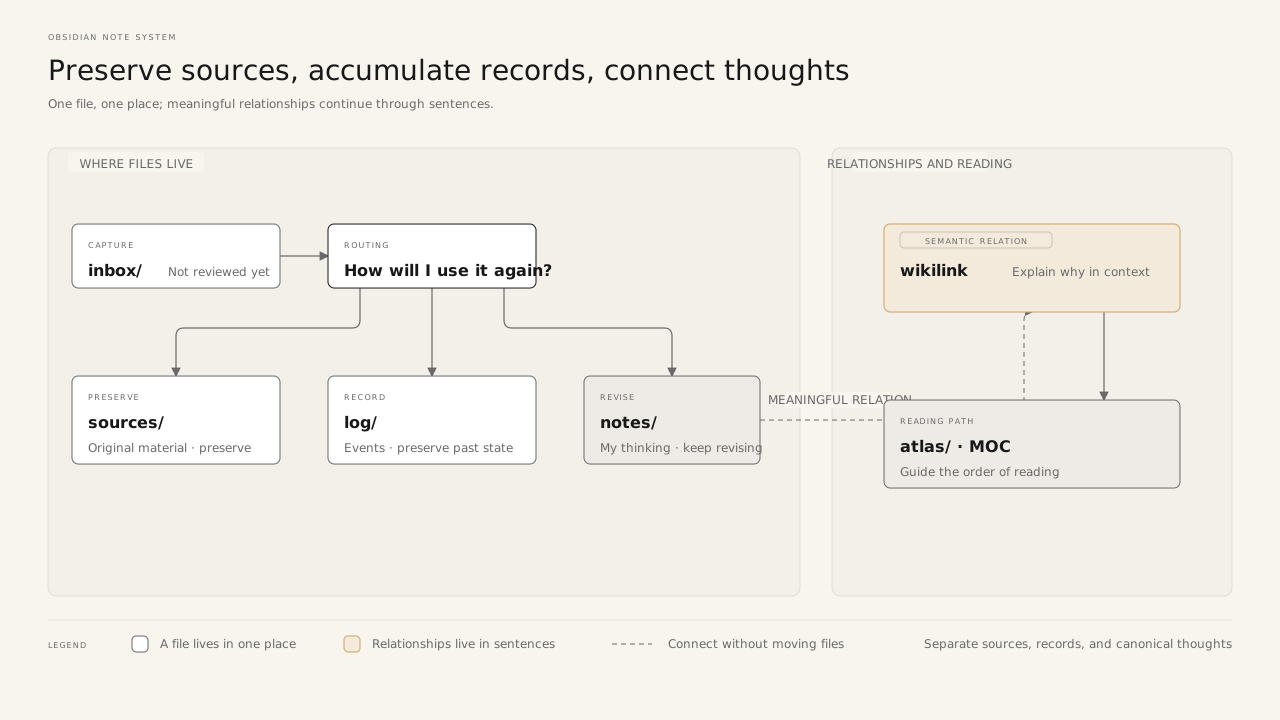
A file lives in one place, while meaningful relationships can keep extending through links.
Preserve original material under sources/
sources/ stores work I did not create. It preserves what I learned from an external article, video, or document so I can refer to it later. The important part is not writing the perfect summary, but preserving which words and ideas came from the source.
For that reason, I do not rewrite the body of a note under sources/. I keep the referenced URL or a line identifying the source, along with what I read there. If my interpretation changes and I rewrite the old source note to match it, the boundary between source and interpretation disappears.
The word sources appears both as a folder and as a Property. Their roles differ. sources/ is where I preserve someone else’s original material. The sources property is a list of evidence—the URLs or source notes supporting the current note. The shared name does not mean recording the same information twice.
If an external article prompts a thought of my own, I do not append it to the source note. I create a separate note under notes/ for my understanding or for a judgment applied in another context. When I return to the source later, I can still distinguish what the author said from what I took from it.
Accumulate the state from the time under log/
log/ is where I keep events and judgments from a particular time: what was discussed in a meeting, how far a project had progressed, or what decision I made about investing or daily life.
A log is not a document that my present self rewrites after reevaluating the past. It preserves what I knew and chose at the time. When my thinking changes, I would rather continue the interpretation in a new notes/ file than rewrite the old log to match my current conclusion. Even a bad decision becomes useful retrospective material when it remains in its original state.
That does not mean every temporary memo belongs in log/. Something I have not judged yet goes to inbox/ first. After reviewing it, I create a new canonical note in sources/, log/, or notes/ and connect it to the original capture. If the capture has no independent value, I delete it after checking its references. It becomes a log only when the context of the event itself is worth preserving.
I use the same rule when a project ends. Meeting notes and progress records stay under log/. Only principles or explanations reusable in other contexts are extracted into a separate notes/ file and linked back to the records. A project MOC is not automatically archived just because the project ended. I freeze it with state: archived only when I will no longer revise it but it remains useful for exploration or retrospection. Keeping historical records and reusable knowledge out of the same file matters.
Rewrite my own thinking under notes/
notes/ is where I keep writing that is mine and that I expect to revise: explanations rewritten in my own words after reading external material, principles found across several experiences, and concepts refined whenever a counterexample appears.
These are not documents I finish once and close. When I encounter new evidence, I return to the same note, revise its sentences, add exceptions, and remove what no longer holds. Creating a new file for every thought I intend to keep referencing would leave several similar canonical notes.
Suppose I read an article claiming, “This is the cause of the incident.” I preserve the source under sources/. I record the incident I actually experienced, or the judgment from its meeting, under log/. If I want a principle that applies across several cases, I rewrite it in my own words under notes/. The three records cover the same subject but have different futures.
A wikilink preserves a relationship in a sentence
A tag answers, “Under what topic will I look for this again?” A wikilink answers, “What is it connected to, and in what way?” Instead of collecting every link in a list, I place it in the sentence that can explain its context.
Keeping sessions off the server means [[statelessness-in-system-design|moving session state to an external store]].
This lets me write a natural sentence without forcing the title of the linked note into it. Someone following the link can also see that the two notes are not connected merely because they share a word, but because one judgment leads to the other.
Proper names and concepts work well as wikilinks. Instead of creating another kubernetes tag just because Kubernetes appears, I can link [[Kubernetes]] and explain in the sentence whether it is a cause, example, or application. aliases can connect other names for the same subject.
I do not make a rule that every shared topic requires a wikilink. A tag is better when I repeatedly search for a topic across contexts. Conversely, a source note with no relationship to express is fine without a link. What matters is not the number of links, but whether the relationship will make sense when I read it again.
Questions decide where a new record begins
When I encounter something new, I do not try to guess its perfect note type. I ask these questions in order to decide where the new record begins.
| Question | Answer | Location and future treatment |
|---|---|---|
| Have I not judged it yet? | Yes | Review it under inbox/ and process it within 30 days |
| After review, did it come from an external source? | Yes | Preserve the source and provenance under sources/ |
| If I created it, will I keep revising it? | No | Keep the state from that time under log/ and append records |
| If I created it, will I keep revising it? | Yes | Update it under notes/ as evidence and counterexamples appear |
Afterward, if another note has a meaningful relationship, I create a wikilink in the body. When I repeatedly read a group of notes together, I create a MOC under atlas/ and explain why each link should be read. Folders decide how a file is treated; links and MOCs create other reading paths without moving it.
Consider an investigation into a Kubernetes incident. Official documentation belongs under sources/; the meeting and judgment at the time belong in log/YYYY-MM-DD-incident-report.md; a principle that applies across incidents belongs under notes/. Inside the notes/ text, I connect [[Kubernetes]] and related concepts. I create a MOC only when the need to revisit that path emerges. Separating the roles does not weaken the connections. It makes them clearer.
Separation does not break the connections
I used to think dividing folders would scatter related things across different places. Now I think the opposite. When sources, records, and interpretations are mixed in one file, I have to decide what may be edited every time I open it. Separating roles makes the lifetime and responsibility of each note explicit.
sources/ protects someone else’s words. log/ preserves who I was at the time. notes/ is where my current self keeps revising. A wikilink connects their meaningful relationships in sentences. If the spatial axis decides where a file lives, and the time axis examines when attention returns and closes, this post is about where actual records are preserved and how they remain connected.
A note system was never a classification table that had to explain everything at once. Do not rewrite source material to match current thinking. Do not overwrite a historical record with a later conclusion. Revise only my own thinking as the evidence changes. At the moment, I think this distinction gives back a surprising amount of time.